Books on meta-analysis and systematic reviews
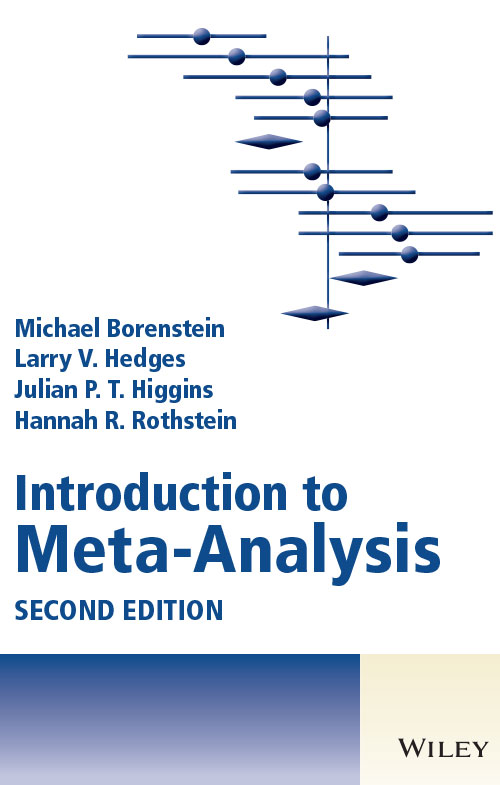
Introduction to Meta-Analysis, 2nd Edition
Michael Borenstein, Larry V. Hedges, Julian P.T. Higgins, Hannah Rothstein
Publisher: Wiley
This book provides a very clear overview of meta-analysis – what it is, why we use it, how to perform and interpret a meta-analysis, and how to avoid common mistakes. It starts with basic ideas (how to compute an effect size and perform a simple analysis) but then moves on to more advanced issues (subgroups analysis, meta-regression, multiple outcomes, publication bias). While the book’s approach is primarily conceptual, it includes formulas and worked examples that serve both to illustrate the concepts and to provide practical advice. The worked examples can be accessed here, both as Excel files and as CMA files. This book has been widely adopted as a text for meta-analysis courses, and has consistently been a best-seller on Amazon since its release.
Download chapters and datasets:
Book details
Download chapters
Support files for book
Order Online
Common Mistakes in Meta-Analysis and How to Avoid Them (2019)
Michael Borenstein
Among the thousands of meta-analyses that have been published over the past several decades, there are a number of mistakes that appear on a fairly regular basis. This book outlines the most common mistakes, using examples in medicine, epidemiology, education, psychology, criminal justice, and other fields. For each, it explains why it is a mistake, the implications of the mistake, and how to correct the mistake. The book is intended primarily for researchers, and so the discussion is conceptual rather than statistical. The examples show the real-world consequences of the mistakes, explaining (for example) how the mistakes can lead to the adoption of interventions that may actually be harmful in some populations. The book includes a section with examples that show how to report the results of an analysis correctly. These examples can serve as templates for reporting an analysis, while avoiding the mistakes discussed in earlier chapters.
Download chapters and datasets:
Book details
Download chapters
Support files for book
Order Online
The Handbook of Research Synthesis and Meta-Analysis, 3rd Edition (2019)
Harris Cooper, Larry V. Hedges, Jeffrey C. Valentine (eds.)
New York: Russell Sage Foundation
This book is a classic. Recognized as the definitive resource for research synthesis when published in 1994, updated in 2010 and again in 2019, this work remains the first book many people turn to. The book is arranged as an encyclopedia, with each chapter written by experts in a specific aspect of research synthesis. However, the editors also arranged for the chapter authors to use the same datasets and style throughout, so the book flows naturally from one section to the next, and offers an excellent overview of the field for statisticians and researchers alike. In the third edition, the editors present updated versions of classic chapters and add new sections that evaluate cutting-edge developments in the field. This edition of the Handbook provides comprehensive instruction in the skills necessary to conduct research syntheses and represents the premier text on research synthesis.
Order Online
Statistical Methods for Meta-Analysis (1985)
Larry V Hedges & Ingram Olkin
New York: Academic Press
Like “The Handbook”, this book, published in 1985, helped to open the field of meta-analysis to a generation of researchers, became an instant classic, and remains a valuable resource to this day. Where "The Handbook" covers many aspects of research synthesis, this volume focuses almost exclusively on meta-analysis (the statistical component of research synthesis), and does so from a mathematical perspective.
Order Online
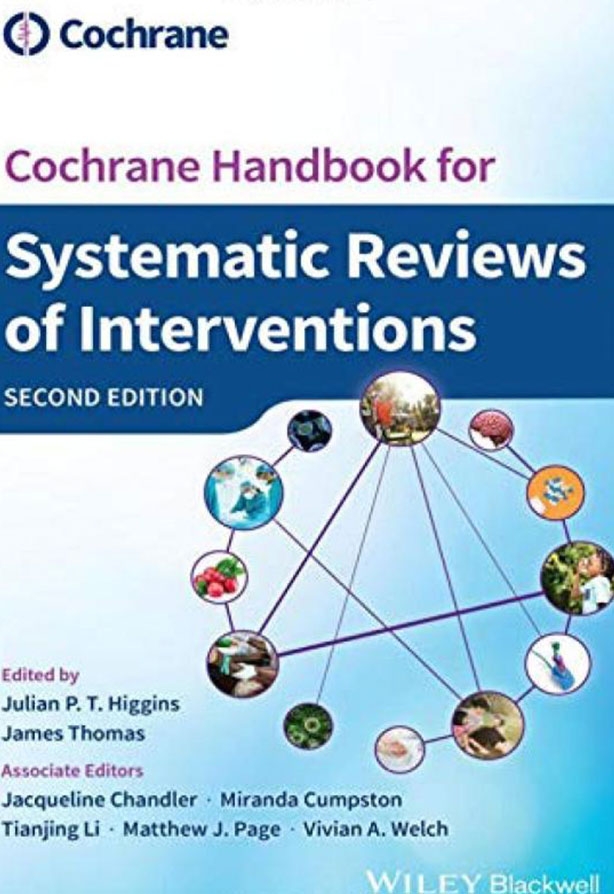
Cochrane Handbook for Systematic Reviews of Interventions, 2nd edition (2019)
Julian P.T. Higgins & James Thomas (eds.), Jacqueline Chandler, Miranda Cumpston, Tianjing Li, Matthew J. Page, Vivian A. Welch (co-eds.)
Hoboken, NJ: Wiley-Blackwell
This book is the essential manual for all those preparing, maintaining and reading Cochrane reviews of the effects of health interventions. The fully updated second edition contains extensive new material on systematic review methods addressing a wide-range of topics including network meta-analysis, equity, complex interventions, narrative synthesis, and automation. Also new to this edition, integrated throughout the Handbook, is the set of standards Cochrane expects its reviews to meet. Designed to be an accessible resource, the Handbook will also be of interest to anyone undertaking systematic reviews of interventions outside Cochrane, and many of the principles and methods presented are appropriate for systematic reviews addressing research questions other than effects of interventions.
Order Online
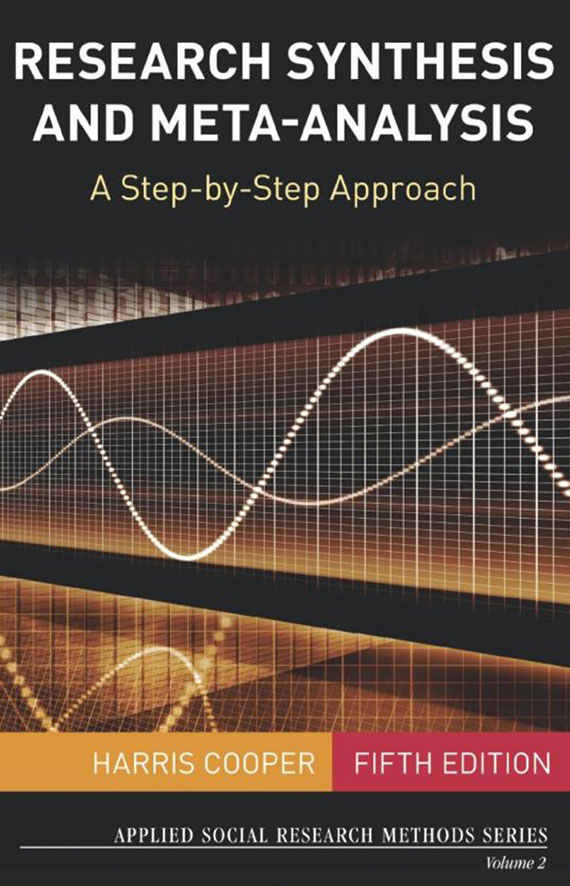
Research Synthesis and Meta-Analysis: A Step-by-Step Approach, 5th edition (2019)
Harris Cooper
Los Angeles: Sage
This book focuses on that part of the research synthesis that is not the meta-analysis: How to formulate the research question, locate the relevant studies, code the data, interpret and present the analysis. This book puts the meta-analysis endeavor in context, and is an invaluable (and very readable) resource, both for researchers and as a text in courses on meta-analysis. Written in plain language with four running examples drawn from psychology, education, and health science, this book offers practical advice on how to conduct a synthesis of research in the social, behavioral, and health sciences. With ample coverage of literature searching and the technical aspects of meta-analysis, this one-of-a-kind book applies the basic principles of sound data gathering to the task of producing a comprehensive assessment of existing research.
Order Online
Practical Meta-Analysis (2000)
Mark Lipsey & David Wilson
Thousand Oaks: Sage
The book’s approach is captured in its title. The book offers a practical, hands-on approach and as such is probably the best general purpose introduction to meta-analysis. It offers an overview of all aspects of research synthesis, and a non-technical introduction to the statistical aspects of meta-analysis. This book can serve as a text for short courses in meta-analysis.
Order Online
Systematic Reviews in Health Care (2001)
Matthias Egger, George Davey-Smith & Douglas G. Altman, Foreword by Iain Chalmers
This edited volume does for systematic review in medicine what "The Handbook of Research Synthesis" does for research synthesis (primarily) in the social sciences. It provides an overview of the field and then explores specific issues in detail. These include statistical issues, but also such issues as standards of evidence, the use of observational studies in meta-analysis, practical implications of heterogeneity, and so on. While this volume is geared primarily toward researchers in the medical fields, the issues raised are relevant also to the social sciences and other fields.
Order Online
Methods for Meta-Analysis in Medical Research
Alex J Sutton, Keith R. Abrams, David R Jones, Trevor A Sheldon, Fujian Song
Like “Systematic Reviews in Health Care”, this book draws examples primarily from medicine and epidemiology, but the focus here is more on statistical issues and less on the broader framework of systematic reviews. There is surprisingly little overlap between the two books. Many of the topics covered in either book are not covered in the other and when the two books do address the same issue, each tends to provide a somewhat different perspective. The style is clear and relatively non-technical, and the examples are used effectively. As was true of “Systematic Reviews”, the issues covered in this book are relevant also in fields other than medicine, and anyone engaged in meta-analysis or research synthesis will find this to be a valuable resource as well as an excellent read.
Order Online
Publication Bias in Meta-Analysis
Hannah Rothstein, Alex Sutton, Michael Borenstein
Chichester: Wiley
Meta-Analysis provides a mathematically accurate synthesis of the available data, but cannot guarantee that the available data is unbiased. In fact, it has been shown that researchers are more likely to publish studies that yield relatively large treatment effects than studies which yield more modest effects, which raises the concern that any synthesis of published data can yield an exaggerated effect. This book traces the history of the problem, explains how to assess the potential impact of bias in any given meta-analysis, and discusses mechanisms that are being adopted in hopes of minimizing the potential for bias in the future.
Order Online
How Science Takes Stock: The Story of Meta-Analysis (1999)
Morton Hunt
New York: Russell Sage
This book discusses the history of meta-analysis over the past several decades – how it emerged as a field, what role it has played in medicine and social science, and so on. Mr. Hunt is a journalist, and this book reads like an extended article in the Science section of the New York Times – interesting, very well written, and informative. The book provides a glimpse at some of the people responsible for the development of this field, some of controversies that have developed around it (“Apples and Oranges”, “Garbage in, Garbage out"), and how meta-analysis is likely to affect the practice of research and policy in the future.
Order Online
Methods of Meta-Analysis: Correcting Error and Bias in Research Findings (3rd edition) 2014
John E. Hunter and Frank L. Schmidt
Newbury Park: Sage
This book focuses on the Hunter-Schmidt approach to meta-analysis, and as such it differs from the other books on this page in three ways. It focuses primarily on validity coefficients and standardized mean differences, to the exclusion of other effects size indices. It focuses on artifact corrections, that is, adjusting the point estimates to account for imperfect reliability and range restriction. It weights the studies by sample size, rather than inverse variance. This approach is generally the preferred approach among persons working in Industrial/Organizational psychology, and for these people this book would be the primary resource. For others, this book offers a look at an alternate approach to meta-analysis.
Order Online
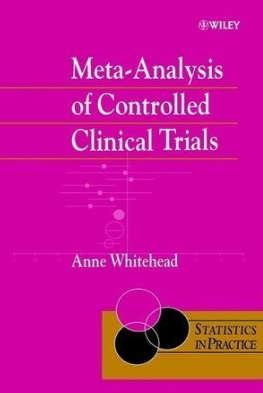
Meta-Analysis of Controlled Trials (2002)
Anne Whitehead
Chichester: Wiley
Where the Egger and the Sutton books attempt to look at the big picture of meta-analysis as part of a systematic review, this volume focuses primarily on the mathematics of the meta-analysis itself, starting with simple examples and moving on to advanced issues. In that sense this volume is similar to Hedges and Olkin’s book on statistical methods, but the Whitehead volume has a more limited focus.
Order Online
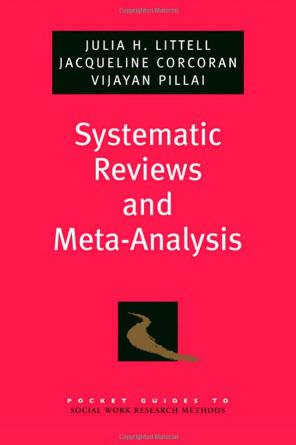
Systematic Reviews and Meta-analysis (2008)
Julia H Littell, Jacqueline Corcoran, & Vijayan Pillai
Oxford : Oxford University Press
This book provides a highly accessible introduction to the concepts and methods of research synthesis, focusing on systematic reviews and meta-analysis. Examples are drawn from social work, social welfare, psychology, and education. Chapters cover topic formulation and protocol development, locating and screening studies, extracting data and assessing study qualities, effect size metrics and pooling methods, assessing bias and variations in effects, and interpreting results. The book is useful for researchers, practitioners, policy makers, and students.
Order Online
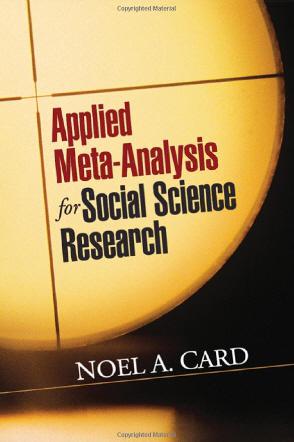
Applied Meta-Analysis for Social Science Research (2012)
Noel A. Card
New York: Guilford Publications
This book offers pragmatic guidance for planning and conducting a meta-analytic review. It is written in a nontechnical style that makes it valuable for graduate students or beginning meta-analysts. The book describes all steps of a meta-analysis, including identifying research questions, retrieving published and unpublished studies, coding, analysis, and write-up. In addition to these fundamentals, the book introduces more advanced topics, including artifact correction, random and mixed-effects models, structural equation representations, and multivariate procedures. A common example is used throughout the book to illustrate these techniques. The book also contains additional user-friendly features, including thoroughly annotated equations and “practical matters” sections based on the author’s experience in publishing meta-analytic reviews.
Order Online
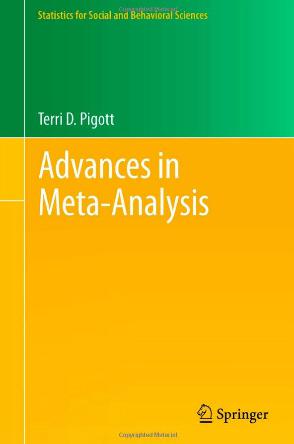
Advances in Meta-Analysis (2012)
Terri D. Pigott
New York: Springer
The subject of the book is advanced statistical analyses for quantitative research synthesis (meta-analysis). It also includes selected practical issues relating to research synthesis that are not covered in detail in the many existing introductory books on research synthesis (or meta-analysis). Complex statistical issues are arising more frequently as the primary research that is summarized in quantitative syntheses itself becomes more complex, and as researchers who are conducting meta-analyses become more ambitious in the questions they wish to address.
Order Online
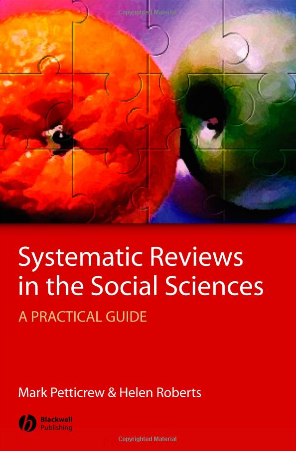
Systematic Reviews in the Social Sciences (2006)
Mark Petticrew & Helen Roberts
Malden: Blackwell Publishing
This book, written by two highly-respected social scientists, provides an overview of systematic literature review methods - outlining the rationale and methods of systematic reviews, giving worked examples from social science and other fields, and applying the practice to all social science disciplines.
Order Online
Modelos Estadísticos en Meta-análisis [Statistical Models in Meta-analysis]. Series in Methodology and Data Analysis in Social Sciences (2010)
Tania B. Huedo-Medina & Blair T. Johnson
A Coruña, Spain: Netbiblio
This book intends to be a guide to learn how to obtain a comprehensive average of the magnitude of effect across studies, assessing the consistency of the results distinguishing among the different statistical models that can be used in meta-analysis, fixed-, random- and mixed-effects. This book is a useful addition to any handbook of meta-analysis for scholars who want to understand and run the three main statistical models that can be applied in meta-analysis.
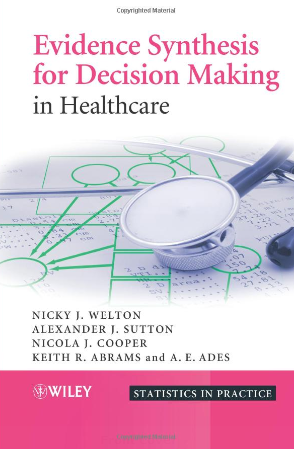
Evidence Synthesis for Decision Making in Healthcare
Nicky J. Welton, Alexander J. Sutton, Nicola J. Cooper, Keith R. Abrams and A. E. Ades
Chichester: Wiley
This book is intended to be used in a wide variety of ways. It will serve as an introduction to evidence synthesis, leading from relatively simple to intermediate level examples. Everything is set within a Bayesian framework, and within a decision-making context, and for those unfamiliar with either of these fields this book should provide a useful introduction. At the same time, the book can be simply taken as a treatise on evidence synthesis.
Order Online

Comprehensive Meta-Analysis
"I was interested in learning how to do a systematic review and meta‐analysis. I've done several courses but couldn't evolve to a complete analysis due to the limitations of available software. Then I became aware of "Comprehensive Meta‐Analysis". The program is very intuitive and the book "Introduction to Meta‐Analysis" is the most objective I've ever read in this topic. I have recommended to those interested in starting training in systematic review to begin by this book and software."
Ricardo Botelho, MD, Ph.D. - Post‐graduate course ‐ IAMSPE, São Paulo, Brazil
"Comprehensive Meta‐Analysis is a fantastic program that allows you to perform advanced meta‐analytic techniques with minimal effort. The graphics editor is especially versatile and allows you to produce high‐quality graphs with ease. Thankfully it doesn't require the complicated codes often necessitated by some statistical programs. On top of that I have found their customer service prompt and helpful and overall I'm very pleased to have purchased the software."
Dr. Richard Mc Gee
"A few years ago after a short survey looking for good software to perform meta-analyses I purchased the CMA and since then I'm using it and enjoying my choice. I think the software is very good, easy to use, and generates everything I need when performing meta-analyses, including the charts."
Dr. Ori Rogowski - Senior Physician, Internal Medicine, Tel-Aviv Sourasky Medical Center, Tel-Aviv, Israel
"The Comprehensive Meta‐Analysis program greatly facilitates conducting quantitative research syntheses. Its graphical capabilities are unmatched and make impressive visual displays of cumulative research findings easy to create. It is user friendly, and its algorithms are well validated in the methodological literature. I recommend it highly."
Steven P. Brown - Bauer Professor of Marketing, C.T. Bauer College of Business, University of Houston
"One of the hardest things for non‐statisticians conducting meta‐analyses is to figure out how to combine data when the data are in different forms. Using continuous outcome as an example, one study might report before‐and‐after scores, and another might report change scores. Comprehensive Meta‐Analysis allows one to take data in any form and seamlessly converts it so that all the data can be included, or tells the meta‐analyst what additional information is necessary to complete the process. This one aspect of the program can save hours of time for non‐statisticians who are not used to converting data from one format to another."
Ian Shrier - McGill University, Canada
Comprehensive Meta-Analysis
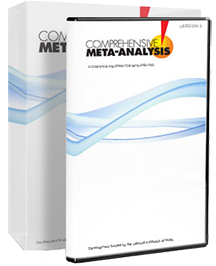
Comprehensive Meta-Analysis (CMA) is a powerful computer program for meta-analysis. The program combines ease of use with a wide array of computational options and sophisticated graphics.